
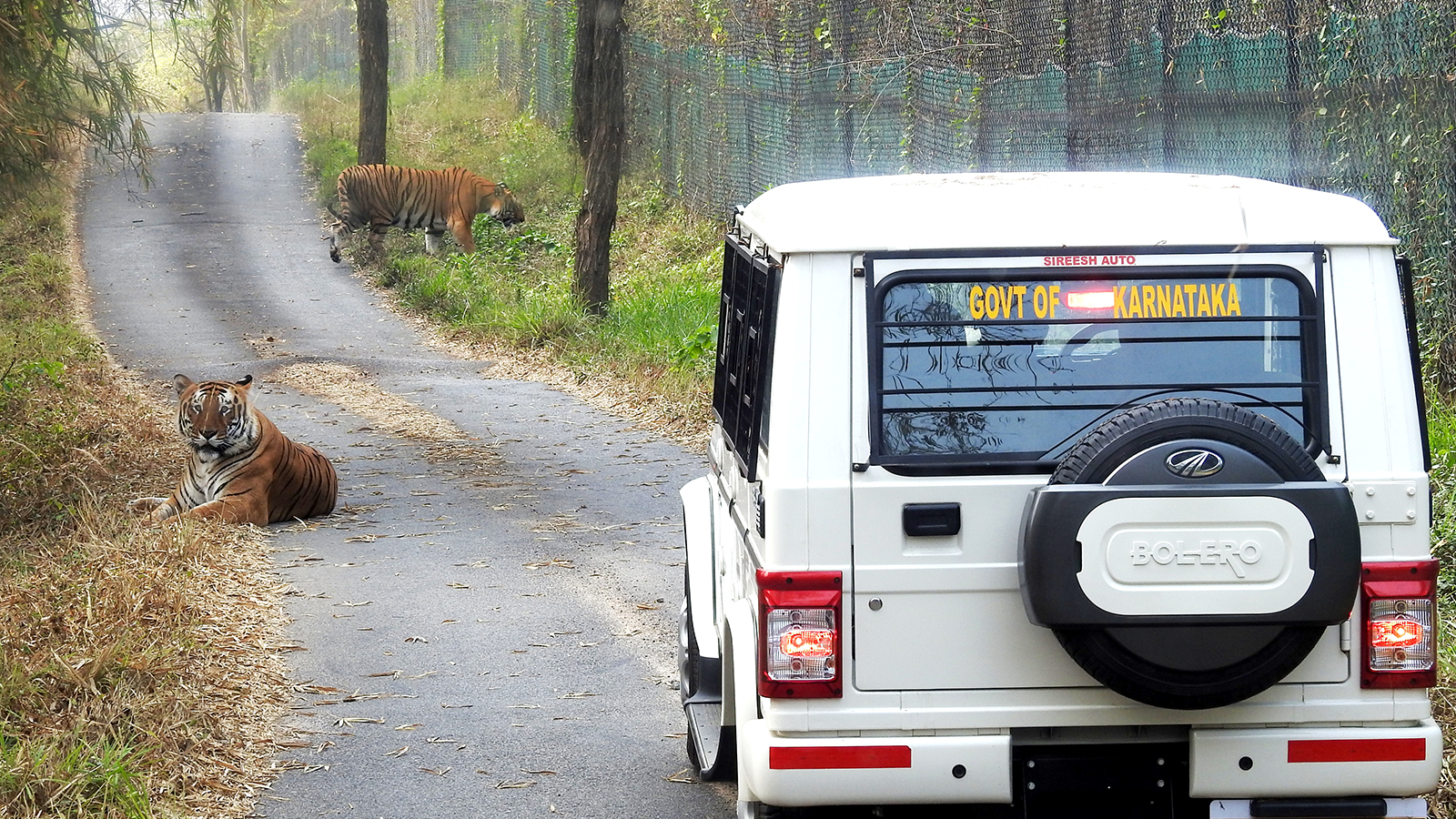
Safari
The Safari Section is the most sought out by visitors, from within and outside India. The Safari unit provides a guided observation of captive wildlife within large-scale, immersive exhibits designed to replicate their natural forest ecosystems. The Safari region's landscape is a representation of the adjoining dry and moist deciduous forests of the Bannerghatta National Park, which is also home to a wide variety of fauna which are often spotted within BBP safari range as well.
The safari is further subdivided into different sections and visitors get to learn and explore the safari area in a protected and closed buses and jeeps which are provided by the zoo, in partnership with the Karnataka State Tourism Development Cooperation (KSTDC).
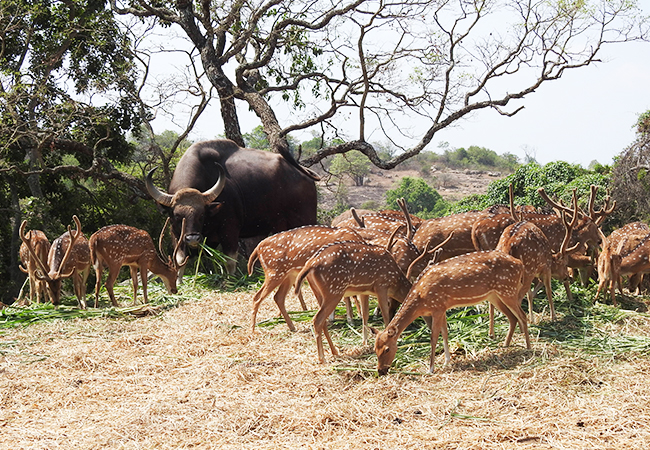
Herbivore Safari
The journey begins with the Herbivore Safari, a massive 68-hectare expanse enclosed by a traditional rubble wall. Here, diverse species of the Cervidae (deer) and Bovidae (antelope and cattle) families roam freely in a shared, naturalistic landscape. This section was developed before the 1970’s but opened to general public only in 2002. Species within this area includes the Spotted Deer, the Sambar Deer, Nilgai, Gaur and the Blackbuck. Various feeding units are located in the viewing vicinity from the safari roads to provide the visitors with a glimpse of the communal feeding of different herbivore species, as they would in their natural habitat. Frequently, young ones of spotted deer, sambar deer and gaur can be spotted as they are breeding well within this area.
The herbivores can also be spotted drinking water in one of the five, interconnected natural lakes, which fill up during the rainy season and sustain even during the summer months. Wide variety of avifauna and reptiles such as Marsh crocodiles are spotted in the water bodies. The common bird species inside the area include Common Moorhen, Bronze winged Jacana, Little Cormorant, Great Cormorant, White throated Kingfisher, Brahminy Kite, Pond Heron, Black Crowned Night Heron, Spotted Dove and Peafowl to name a few. The Sambar deer is a species of the Cervidae family which can be frequently seen in the middle of the lakes, feeding on freely available grass. During the summers they can be spotted near the naturally formed slush ponds drenching themselves to keep cool. The gaur rutting season offers a spine-tingling experience as their powerful, resonant vocalizations echo through the forest.
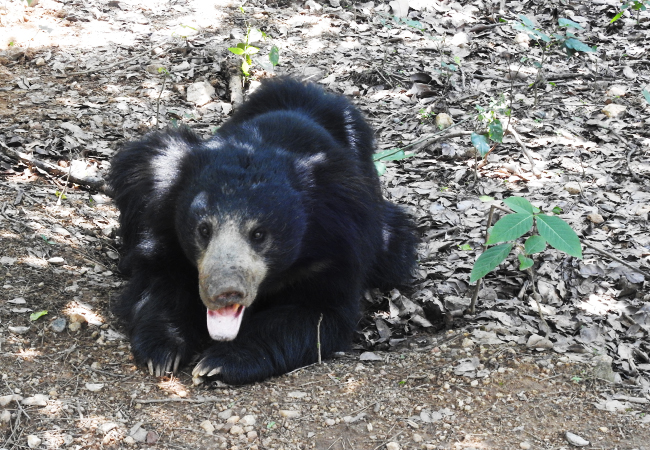
Bear Safari
The Bear safari is home to rescued sloth bears, majority of which were previously exploited as dancing bears by The Kalandar tribes, while the rest were rescued from human-animal conflict or found as abandoned cubs. This 20 hectare region is protected by a dry moat enclosed by solar fences all around the safari along with a double gate system to prevent sloth bears from escaping while vehicles enter and exit the area.
The bears are footloose within this area during the day in compatible groups. Watermelon, honey and other seasonal fruits are scattered across the field in the afternoons to encourage foraging behavior among the bears. This natural habitat is also suitable for the bears to dig the soil to feed on termites. Natural burrows have been created by the bears where they rest during the hot time of the day and return back to their individual holding houses for the night. In their individual holding houses they are provided with finger millet porridge, fruits, milk and eggs both in the morning and in the evening. There 5 blocks of animal housing facilities namely Panchavati, Chitrakuta, Kishkinda, Dr. G.K.V Block and Jambava. The facilities within the Bear Safari are overseen and maintained through a collaborative partnership with Wildlife SOS.
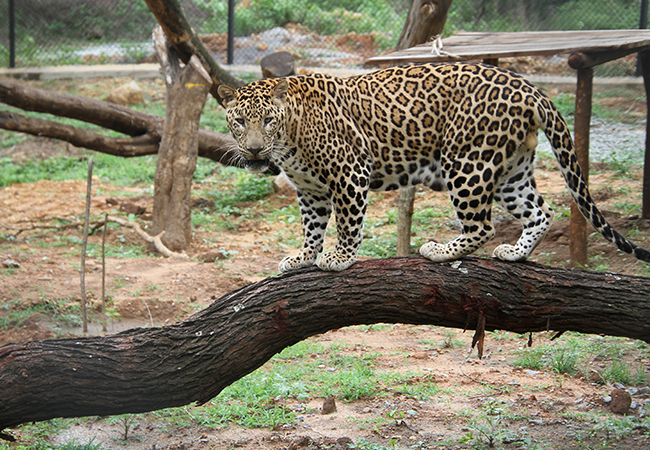
Leopard Safari
Bannerghatta is home to a healthy population of free ranging leopards (Panthera pardus) and the display of captive leopards in this safari unit plays a vital role in highlighting their status as top predators while helping visitors understand these elusive big cats. As per the Central Zoo Authority guidelines for safaris, a 20-hectare area was bounded and rail fenced for the leopard safari. Two holding houses with 6 rooms each linked to a small kraal area and main field are erected for the leopards in the safari.
The leopard safari region features the uneven terrain, natural rocky formations, and the semi-deciduous forest habitat of the National Park. This division is secured by a 4.5‑meter-high vertical chain-link fence, reinforced with MS sheets placed at a 30° incline and 1.5 meters in height. Due to the increasing human animal conflict in recent times, Bannerughatta Biological Park receives a large number of leopard cubs rescued from all across the state. These rescued cubs are hand raised and shifted to the leopard safari section to help visitors learn about these big cats. It also provides the general public with the opportunity to learn why the human-animal conflict in recent times are increasing and also the ways to contribute towards conserving them. The Leopard Safari wing was inaugurated by the Hon’ble Forest Minister Sri Eshwar B Khandre (Government of Karnataka) on 26-06-2024 offering visitors the chance to observe leopards in a naturalistic environment. Additionally, 4 acres of land within the safari area is separated using solar fences as an added managemental practice to help these animals adjust to their new environment and navigate their way back to holding houses in the evening.
Lion Safari
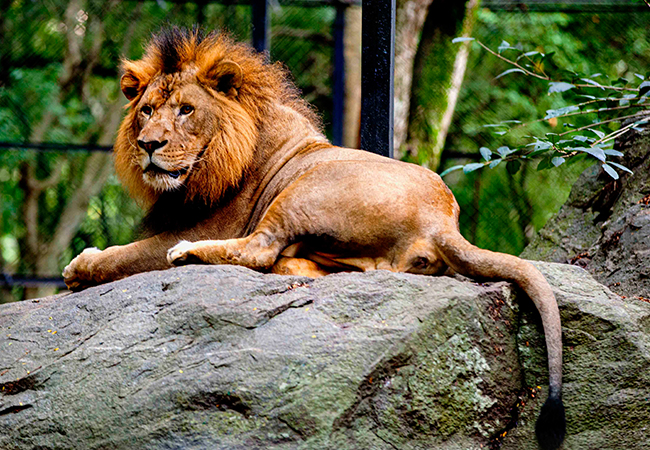
The Lion Safari section is barred by chain-linked meshes, moats and railway lines with a double gate system for entry and exit. The first carnivores are the lions. Their prides are grouped by compatibility and allowed into the safari field in rotation. Visitors can see these majestic animals resting and interacting near the natural lake among bamboo clusters.
Tiger Safari
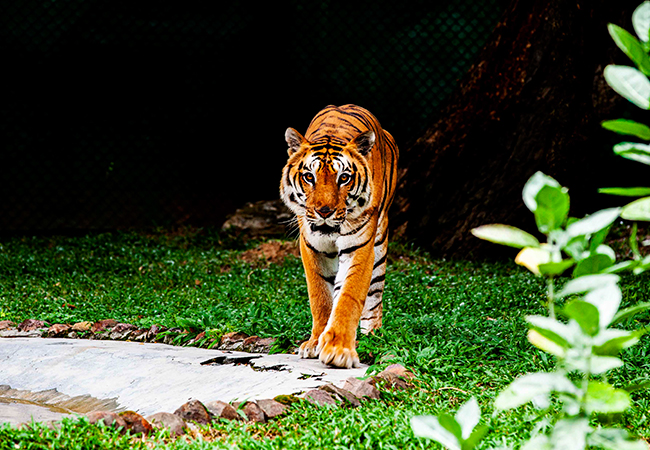
The last section of the safari right across the fields houses the colored and leucistic Royal Bengal Tigers. They camouflage perfectly in the tall grass and bamboo thickets, adding excitement as visitors search for these endangered big cats in the safari area. They can be seen scent marking, clawing trees, resting in waters or between grasses, occasionally surprising visitors with close encounters next to the safari vehicles.
Aside from the safaris, visitors get a glimpse of the Lungs of Bengaluru- “Bannerghatta National Park”. This area can be seen while returning back from the tiger safari. Bannerughatta Biological Park is carved out of the National Park, and it is the northern most tip of the Mysore Elephant Reserve. With undulating terrains of broken chains of hills and rocky outcrops, it is a vital corridor for elephants and other wildlife. Existing rocks are made of coarse granite and complex GNEISS which are a part of The Peninsular GNEISS. Since vegetation in the biological park is similar to that of the National Park, some of the commonly found tree species are of Peepal, Indian fig tree, Neem, Gooseberry and Ashoka. This diverse selection of flora attracts a wide variety of birds. According to The Champion and Seth classification of Indian forests, upper regions have southern tropical dry deciduous forests with red-gravelly soil and valley regions have southern tropical moist deciduous forests with sandy loam soil. The Bannerughatta Biological Park Safari is an educative experience for visitors to explore the untamed beauty of the forest. It gives us a rare chance to learn about captive wildlife in its natural habitat safely with minimum disturbance to the animals with the hope that it motivates us to adopt green lifestyles to contribute a bit towards nature and wildlife conservation.